
Self-Injection Guide
Subcutaneous (Sub-Q) Injections
Sub-Q injections deliver medication just under the skin, where it's absorbed slowly into the bloodstream. This guide walks you through every step — choosing a site, drawing up your dose, and injecting with confidence.
The Basics
What Is A Subcutaneous Injection?
A subcutaneous injection is a shot given into the fat layer between the skin and the muscle. Sub-Q injections are used to give very small amounts of medicine.
All GLP medications are given subcutaneously.
New To This? That's Normal.
Almost everyone feels uncertain the first time. Read all the way through once before you open anything, then work through it step by step with your supplies in front of you.
Your Equipment
Know Your Syringe
There are three parts to a syringe. The needle goes into your skin, the barrel holds the medicine and has markings on it like a ruler, and the plunger moves medicine into and out of the syringe.
Reading The Markings
The syringe is marked from 10 to 100. The marking at 100 is the same as 1 mL, and the marking at 50 is the same as 0.5 mL. A 25 unit dose sits halfway between the 20 and 30 marks.
Step By Step
How To Draw Up Your Medication
You'll pull up your medication by units. The number of units depends on the concentration of your vial — the milligrams of medication per milliliter.
Always Check Your Rx Summary First
Concentrations vary from pharmacy to pharmacy and from medication to medication. Review the Rx Summary for your specific medication every single time before injecting — never assume this vial matches your last one.
1
Read Your Instructions
Look carefully at the instructions listed on your medication as well as on your Rx Summary, and confirm the number of units you need.
2
Clean The Vial Top
Clean the vial top with an alcohol wipe (or isopropyl alcohol and gauze) before each use to maintain the sterility of your medication. Let it dry completely before puncturing the vial.
3
Pull In Air To Your Dose
Hold the syringe with the needle pointed up. With the cap still on, pull back the plunger to the line for your dose. This fills the syringe with air.
For example, for a 25 unit dose, pull the plunger to the line halfway between 20 and 30.
4
Push The Air Into The Vial
Remove the cap and insert the needle into the rubber top of the vial. Do not touch or bend the needle. Depress the plunger and push the air in — this keeps a vacuum from forming so the medicine flows easily into the syringe.
5
Invert And Draw
Turn the vial upside down and hold it up in the air. Make sure the medicine covers the tip of the needle the entire time. Pull back the plunger to the line for your dose, just as you did before.
6
Remove The Needle
Take the needle out of the vial. Your medicine is ready to inject.
Placement
Where To Give The Injection
Three areas work for subcutaneous injections. The shaded zones show where the injection can go.

Site One
Abdomen
Uncover your abdomen. You may give an injection below the waist to just above the hip bone, and from the side to about 2 inches from the belly button. Avoid the belly button.
Site Two
Thigh
Uncover the entire leg. Find the area halfway between the knee and hip and slightly to the side. Gently grasp the area to make sure you can pinch 1 to 2 inches of skin.
Site Three
Easier With A HelperUpper Arm
Use the fatty tissue at the back of the upper arm, halfway between the elbow and the shoulder, avoiding the muscle. Grasp the skin between your thumb and first two fingers — you should be able to hold 1 to 2 inches. Reaching the back of your own arm is awkward, so many people have someone else give this one.
Skin Health
How To Choose The Best Place
It is important to use a different site each time you give an injection. This prevents scars and skin changes.
- Keep the sites at least 1 inch away from each other.
- Keep track of where injections are given — write down the date, time, and site each time.
- Work your way around your available sites rather than favoring one spot.
Use The Tracker
Tap the site you used and this page will remember it on this device — a simple way to keep your rotation on track between doses.
Injection Site Tracker
Tap the site you just used.
Gather Everything
What You Need
Lay everything out on a clean surface before you begin, and check it off as you go.
Wash Your Hands First
Soap and warm water, dried completely, before you touch any of your supplies.
Needle Size
Subcutaneous injections typically use a short needle, around 4 to 8 mm (5/16 to 5/8 inch), depending on your medication.
0 of 4 ready
The Injection
90 Degrees Or 45 Degrees?
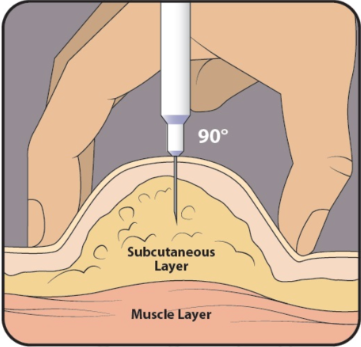
Subcutaneous injections can be given straight in at a 90 degree angle or at a 45 degree angle. How much skin you can pinch decides which one you use.
How To Give The Injection
1
Open The Alcohol Wipe
Wipe the area where you plan to give the injection and let the area dry. Do not touch this area again until you give the injection.
2
Prepare The Needle
Hold the syringe with your writing hand and pull the cover off with your other hand. Place the syringe between your thumb and first finger, letting the barrel rest on your second finger.
3
Grasp The Skin
With your other hand, grasp the skin at the site you cleaned.
4
Insert The Needle And Inject
Hold the syringe barrel tightly and use your wrist to insert the needle into the skin. Once the needle is all the way in, push the plunger down to inject the medicine.
5
Pull Out The Needle
Remove the needle at the same angle you put it in. Gently wipe the area with the gauze pad, or place your bandaid.
Safety
How Do I Get Rid Of Used Syringes And Needles?
It is important to dispose of needles and syringes correctly. Do not throw needles into the trash.
- You may receive a hard plastic container made especially for used syringes and needles.
- You can also use a soda bottle or other plastic bottle with a screw lid.
- Make sure that both the syringe and needle fit into the container easily and cannot break through the sides.
- Keep the container closed and out of reach of children and pets.
Common Questions
Sub-Q Questions
How Many Units Should I Draw Up?
The number of units depends on the concentration of your vial — the milligrams of medication per milliliter. Concentrations vary from pharmacy to pharmacy and from medication to medication, so always review the Rx Summary for your specific medication before injecting.
Why Do I Push Air Into The Vial First?
Pushing in the same amount of air as the dose you're drawing keeps a vacuum from forming inside the vial, so the medicine flows easily into the syringe.
What If I Touch The Needle?
Do not touch or bend the needle at any point. If the needle touches anything other than the cleaned vial top or your cleaned injection site, it is no longer sterile — use a new syringe.
Can I Inject In My Own Upper Arm?
No. The upper arm site requires a helper, because the person giving the injection needs to grasp the skin at the back of the arm from behind.
How Far Apart Do My Injection Sites Need To Be?
At least 1 inch apart. Using a different site each time prevents scars and skin changes.
My Vial Looks Half Empty — Is That Right?
Yes, that's normal. These medications are highly potent in very small doses. The Read & Verify Vials Guide shows how to confirm the total milligrams in your order.
Not Sure About Your Dose?
Check your vial math before you draw up, or get in touch and we'll walk through it with you.
This guide is general education for Lavender Sky Health patients and does not replace the specific instructions on your prescription or the guidance of your care team. Always follow your Rx Summary for your medication, dose, and route.